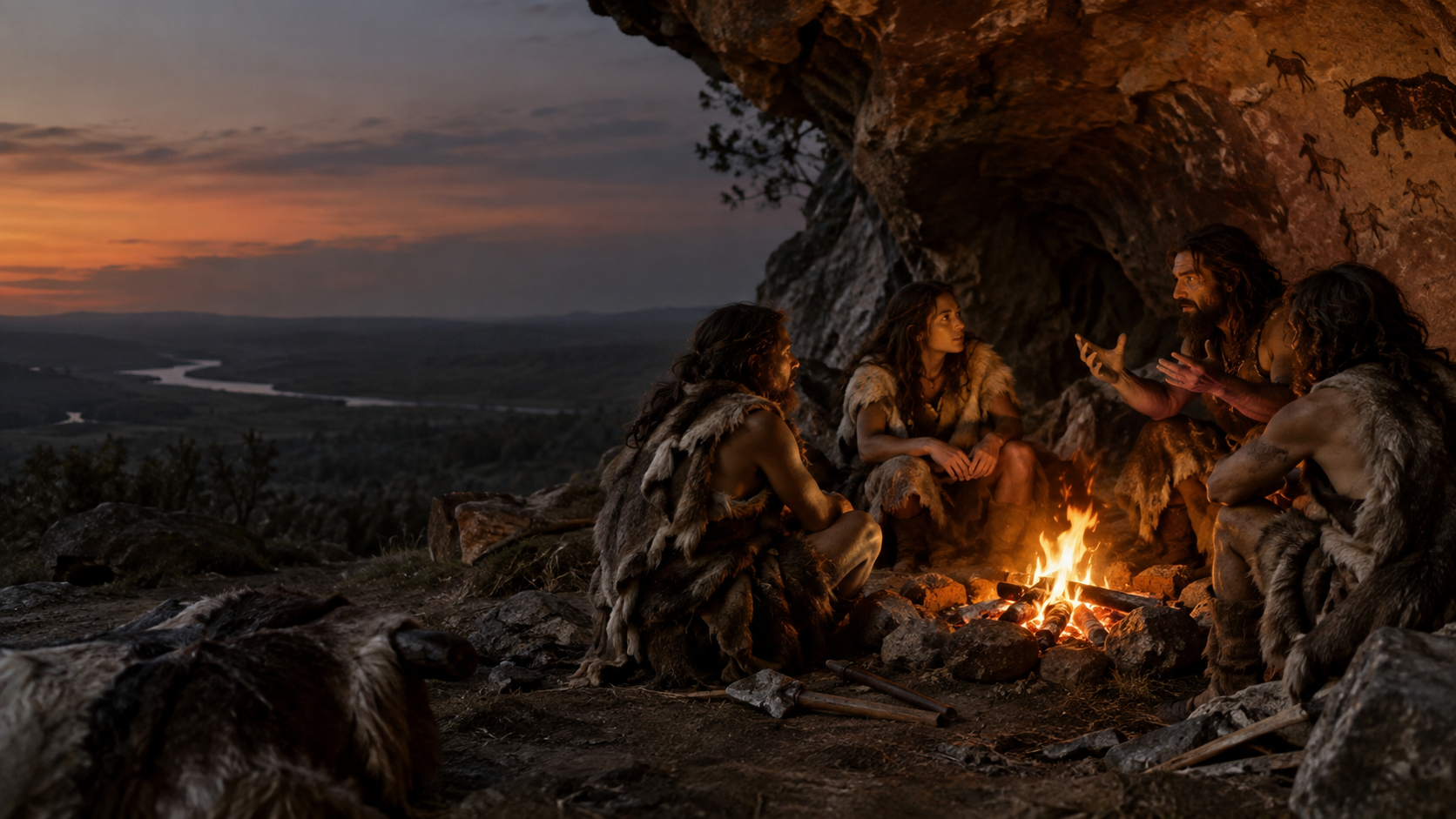
I’m going to be honest here for a minute. When I was registering for fall classes, I was looking for a class that aligned with my requirements and fit the schedule I was trying to build (Tuesday and Thursday 😄). When I searched for HIST, this class came up, but I wasn’t sure if I was going to enjoy it. My thinking was, “Ah, a history class from the beginning of time.” I thought it was going to be boring, but so far, I have been proven wrong.
I have always found history and politics appealing, but I had never really thought about history from 30,000 years ago. Throughout my years in school, we might have learned about prehistory, the Roman Empire, or Mesopotamia, but I don’t really remember much of it.
One of the first readings our professor assigned us was from a book by Yuval Noah Harari called Sapiens: A Brief History of Humankind. One of the many questions the author tries to answer is: What made Homo sapiens different? He goes into detail, giving examples of other human species that were living on Earth and explaining how we weren’t necessarily the strongest of the bunch.
Language Changed Everything
After reading Chapter 2, “The Tree of Knowledge,” one of the first answers that Harari gives to the question of what made Homo sapiens different is language.
At first, this sounds obvious because other animals communicate too. They can warn each other about danger, let others know where to find food, or communicate with members of their group. So, what was so different about Homo sapiens? The difference was that our language became more complicated and more useful. Yes, we could talk about what was happening in front of us and warn other sapiens about danger, but our ability to describe what was happening was a game changer. In the book, he makes the point that a green monkey can yell to other monkeys, “Careful, a lion!” but a modern human can tell a friend that this morning, near the bend in the river, she saw a lion tracking a herd of bison. With this vast amount of information, sapiens could decide if they should go to the river or wait until the lions were gone. We were also able to talk about things that were not happening right in front of us. We could talk about other people, relationships, events, and eventually ideas that did not physically exist at all. Harari connects this change in the way humans communicated with what he calls the Cognitive Revolution.
Why Gossip Mattered
Another part of the reading that was kind of funny was the idea of gossip. When I hear the word gossip, I normally think of people talking about someone behind their back, so it does not sound like something important to human evolution. But the more I thought about it, the more it actually made sense.
If you were living in a small tribe, knowing what was going on around you was probably very important to survival. Knowing who you could trust, who was causing problems, or who was helping the group must have been valuable information. Harari explains that this type of social information helped humans build and maintain bigger groups, with these close social groups often reaching around 150 people. I thought that was a lot because right now I probably couldn’t name 150 people that I actually know.
But for me, the most interesting part comes after that.
The Power of Shared Ideas
This is where things started to get really interesting for me because so much of the world we live in today depends on people believing in things together. Harari talks about things like religion, nations, money, laws, and companies. These things are real in the sense that they affect our lives every day, but they only really work because large groups of people agree that they mean something. When I read that part, it made me think: if you think about it, a $20 bill is really just a piece of paper. It only has value because we, as a community of people, have decided to believe that the piece of paper with Andrew Jackson’s face on it has value. The same thing can be said about countries. The land is physically there, but borders, flags, laws, and national identity all depend on people agreeing that those things exist and have meaning.
Another great example that Harari mentions in the chapter is companies. They can own property, hire people, borrow money, get sued, or go bankrupt even though the company itself is not a physical person. It exists because we all agree that it exists and because our laws recognize it that way.
Finally, religion fits into this idea of shared beliefs. Humans have used religion, stories, rituals, and traditions to build and destroy communities for thousands of years. Whether someone personally believes in religion or not, it is hard to ignore how powerful religion can be in convincing groups of millions of sapiens to do good and bad in the name of shared beliefs.
While I was writing my notes for this post, one of the questions I wrote down was:
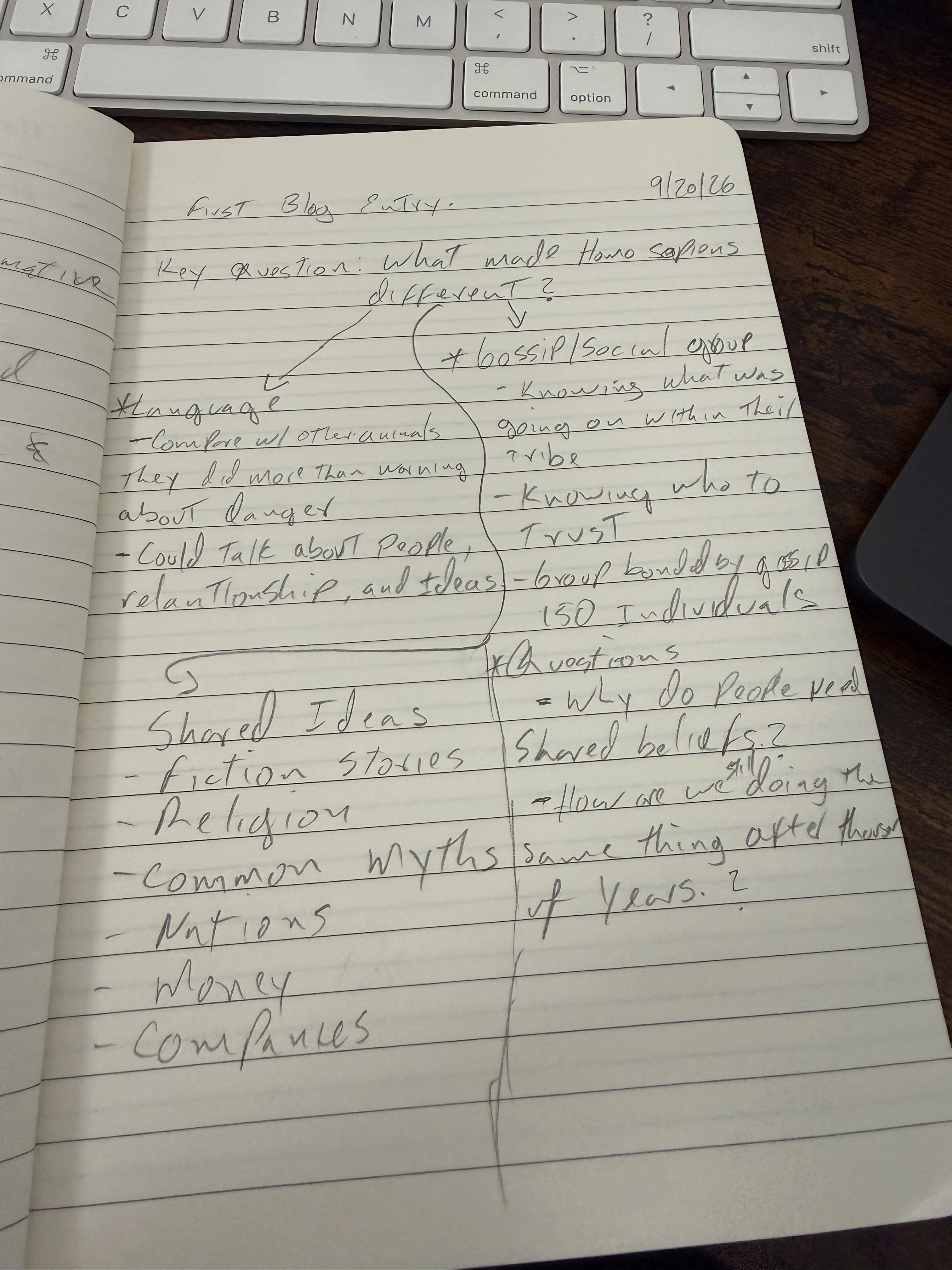
Why Do People Need Shared Beliefs?
The more I thought about that question, the more I started to wonder if we are really that different today.
Thousands of years ago, people organized themselves around gods, stories, traditions, and common identities. Today we still organize ourselves around religion, countries, money, political parties, companies, and other shared ideas. Obviously, the world has changed a lot, but maybe the way sapiens bring ourselves together has not changed as much as we think.
Before taking this class and reading these chapters, if someone had asked me what made Homo sapiens different, I probably would have said tools, intelligence, or maybe our ability to survive. I definitely would not have answered gossip, stories, and our ability to get other people to believe in the same ideas.