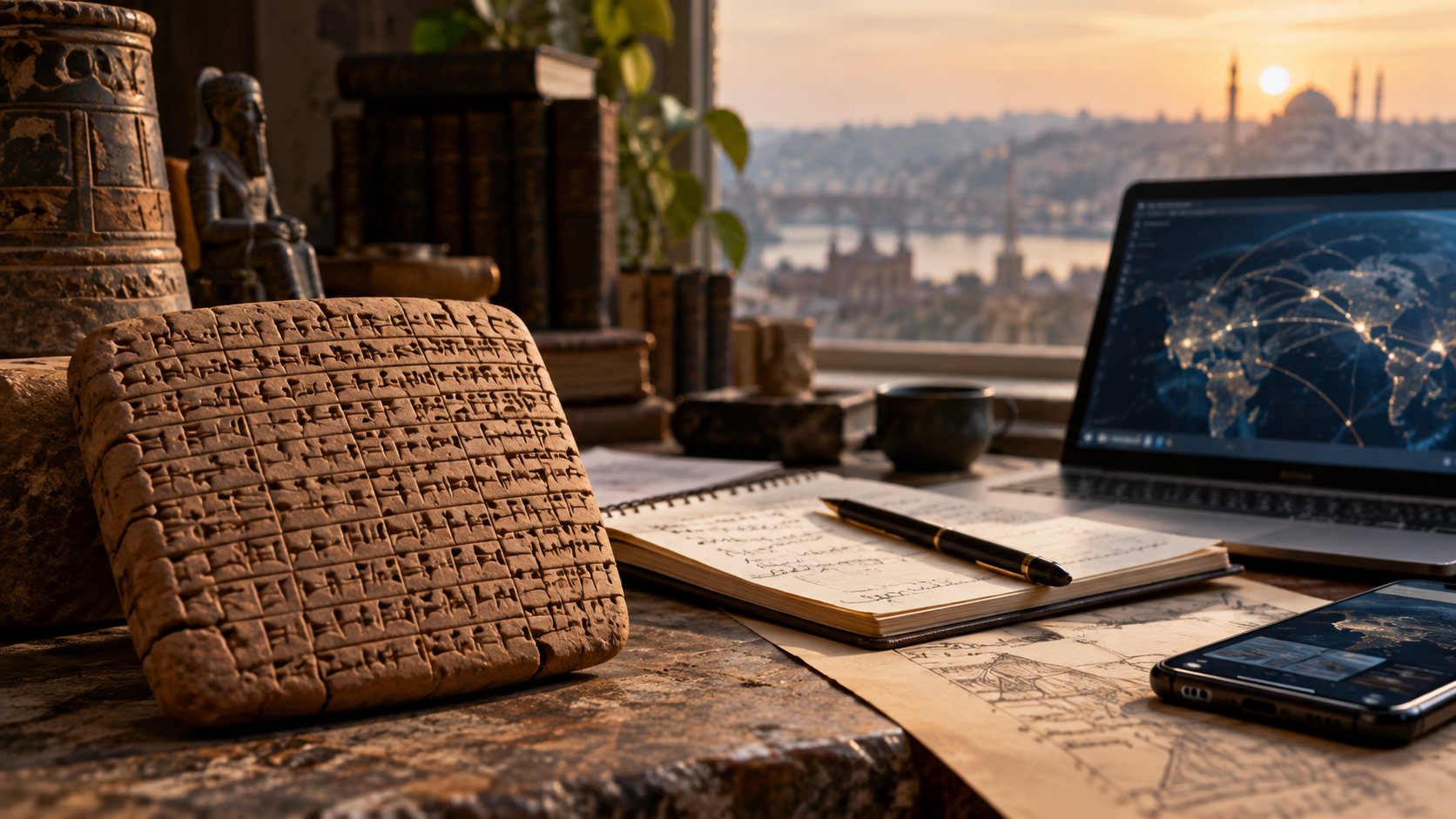
Let’s close our eyes for 10 seconds and imagine today’s interconnected world without writing. How different would the world be without a form of record keeping? Where would Congress keep track of its laws? Where would people learn from if there were no textbooks? Where would the world get its information if there were no newspapers? It is kind of hard to imagine our lives without writing.
The more I thought about it, the more thankful I became that the Sumerians figured it out back in the day ( 3400 BCE or to be exact 5526 years ago). When the Sumerians developed cuneiform, it was not because they wanted to write a novel or tell the news to the people of Uruk. The necessity at the time was record keeping. Today, scientists estimate that the human brain can hold around 1 petabyte of data, which is roughly billions of pages of text or the equivalent of millions of books. The catch is retrieval: actually retrieving and accessing that information in our brains. As society became larger and more complicated, there was simply too much information for people to keep in their heads.
That is probably the part that connected with me the most.
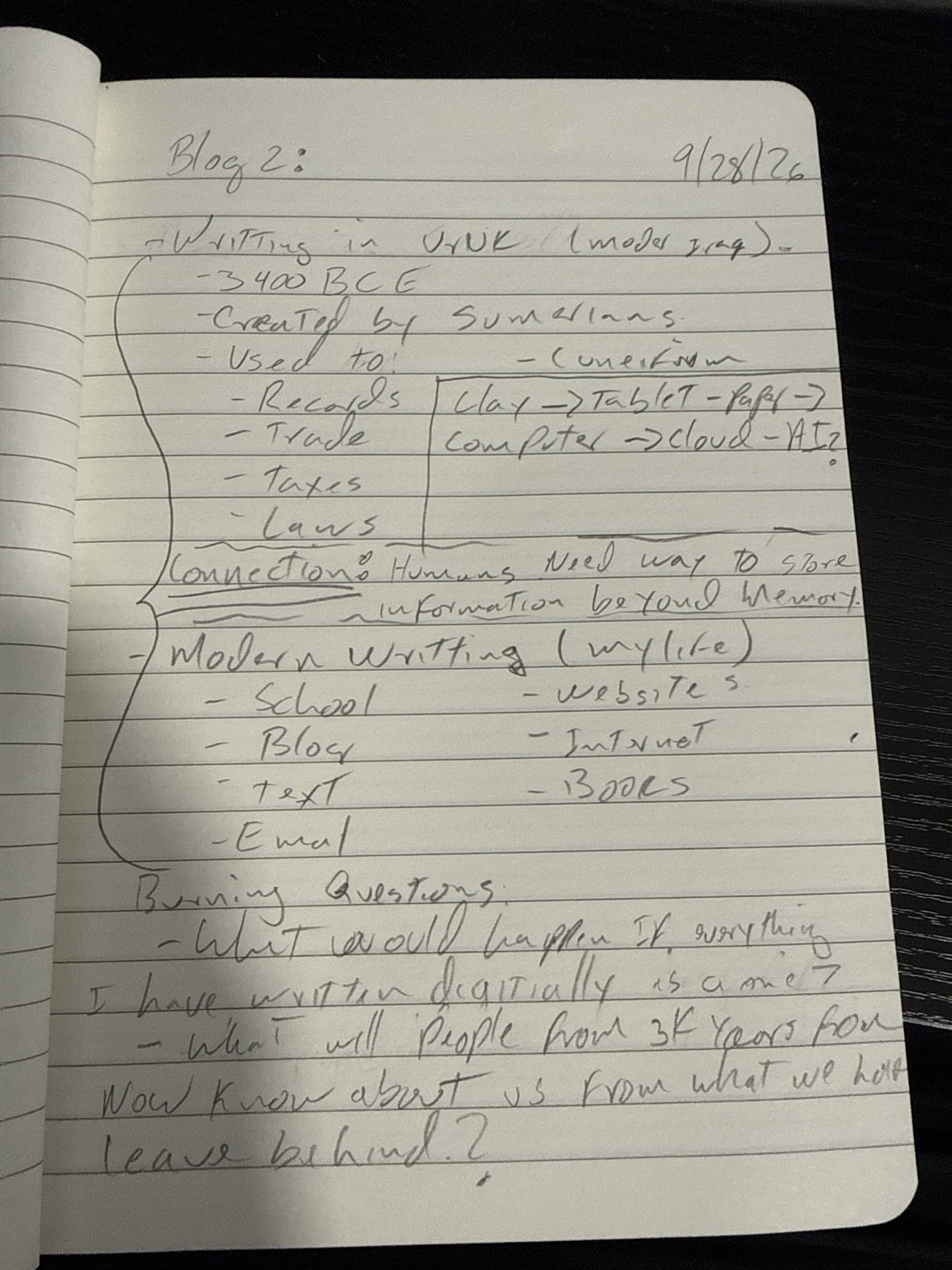
If we really think about it Humans needed a way to store information beyond memory but today we are still trying to solve the exact same problem. The technology has completely changed, but the reason behind it has not. The Sumerians used clay tablets. Later, humans used paper and books. Today, I use computers, websites, email, text message, and the internet. Most of the things I write are not even stored somewhere that I can physically touch they are someone thousands of miles away in some kind of server or the “cloud”. This blog is a great example of that. I’m writing down what I’m learning in the class so that these ideas do not just stay in my head and disappear later. I already know that if I depended only on my memory, I would probably forget most of what I learned in this class a few years from now. Heck, I sometimes have a hard time figuring out what I did last week, if I dont write it down in my calendar app or my notes app is really hard to remember.
Writing must has been one of the greatest life changing events of the time.
Before writing, information depended much more on people remembering it and passing it to someone else. Once humans could record information, that information could exist even after the person who originally knew it was gone. Someone else could read it later. In a way, this is the reason we are able to study Sumer, Mesopotamia, Egypt etc, they left things behind and as we discovered them we learned from them. While I was making my handwritten notes for this post, I drew a simple line:
Clay → Tablet → Paper → Computer → Cloud → AI?
That is obviously a very simplified version of thousands of years of history, but I think it shows the connection I was thinking about. The tools keep changing, but humans keep looking for better ways to save, organized, and share information. That also made me think about a question that is a little uncomfortable.
What would happen if everything I have written digitally disappeared?
We have become so accustom that we turn on our phone or our computer and everything that we have every written or save is there, we don’t even think about how dependent we are on today’s technology. I have homework, messages, documents, pictures, and other files that are imperative to my life and they are all stored digitally. Most of the time I assume that information will always be there. But a clay tabled can survive for thousands of years. Can we honestly say the same thing about a file stored on a computer hard drive or in the cloud? This question lead me to another question that I think is more important.
What will people 3000 years from now know about us from what we leave behind?
I obviously dont know the answer to this question and this is why I choose this topic, is interesting to me to think about this kind of questions. We know things about ancient civilizations because archaeologists have found writing, buildings, objects, and other physical evidence. We are probrably creating more information than any society before us, but so much of it is digital. Maybe people thousands of years from now will have access to extreme amount of information about is. Or maybe all those Facebook post, reddit discussion or Twitter disagreements will disappear because the technology used to store it no longer exists.
When you really stop for 2 minutes and think about it, it changes your perspective.
At first, learning about the Sumer civilization and what was happening in Mesopotamia seemed like one of those things that you just learn in class, study for a test and then move on. But when I started connecting it to my own life, I realized that I use the same basic idea every day. The Sumerians needed a way to record information that human memory could not hold forever. Thousands of years later, we are still doing the same thing. We just traded the clay tablet for the cloud.