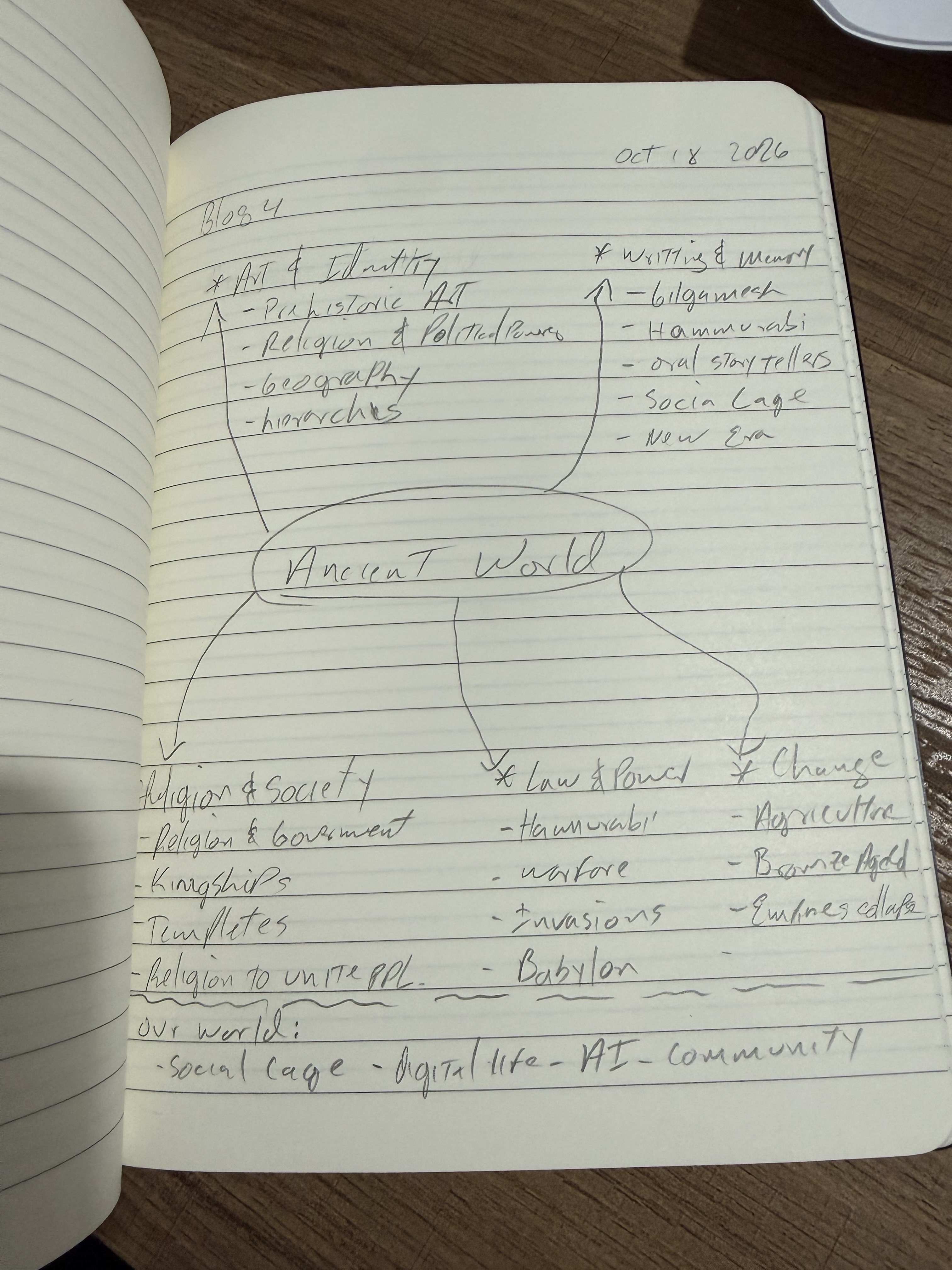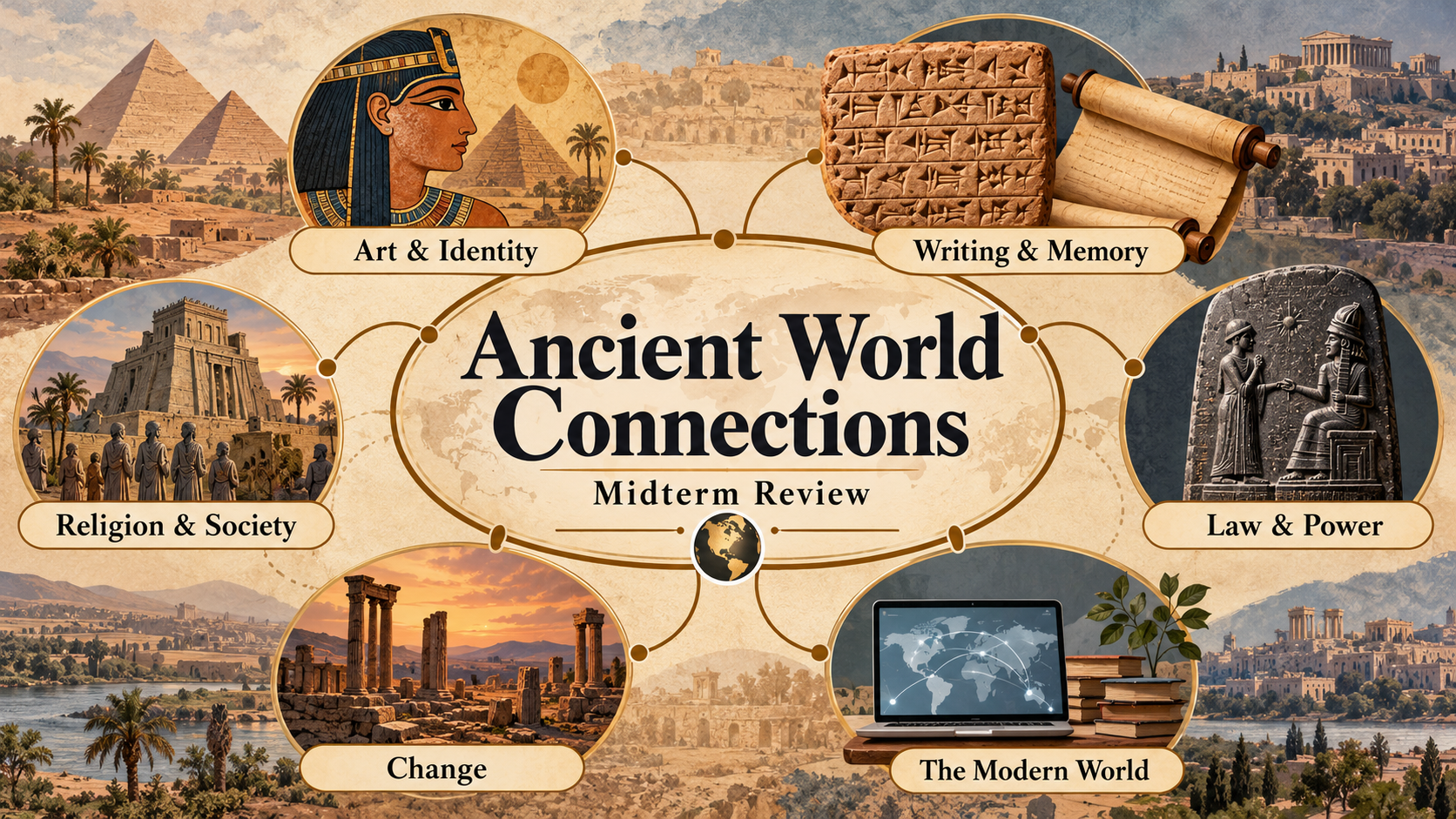
As this post is meant to prepare me for the class midterm, I went at it differently. Instead of going through my notes in chronological order, I separated the material into clusters of information that I think will make it easier to study and learn the information.
Art & Identity: One of the biggest changes I have seen throughout the class was how art has changed as societies became more organized. At the beginning, prehistoric art seemed closely connected with the environment, animals, and early human beliefs, while Egyptian art became much more structured. As discussed in class, the Egyptians changed the game in how they did art. With their recognizable structures, flatness, and hierarchy, we got to see a different type of art with richer meaning and a better understanding of how they behaved as a society. Religion and political power were also connected to art, as rulers and religious ideas were central to Egyptian society.
Writing & Memory: Many historians agree that the change between prehistory and history was the invention of writing, and when you think about it, it makes sense. Before writing, there were few records of anything. Tales were the main way to pass down information between generations, and as I have researched, the human brain can only hold so much. The development of writing changed that forever. Humans were now able to write down information that would outlast them by thousands of years. In class, we studied different types of early writing and stories like the Epic of Gilgamesh, which survived thousands of years after it was written. Also, as societies grew, writing was used for government and law. The Code of Hammurabi was one of the first examples of the rule of law that we experienced as humans. One topic that we discussed in class that I had never thought about was the social cage of writing. Looking at it from the outside, I never thought there was a dark side to writing, but when you research it more deeply, we can see how writing sidelined storytellers and elders, and how it created social classes because not everyone was allowed or had the time to learn how to write and read. Once society became dependent on writing, it was impossible to stop using it, kind of like how our interconnected world looks today. Can we imagine a single day without email and our iMessages?
Religion & Society: From very early human societies, religion has been used as a way to understand the environment and create community. I did not realize how connected religion was to everyday life, politics, and government in many ancient civilizations. Egypt is one example where political and religious authority were closely connected. The Israelites are another important example because devotion to Yahweh became an important part of their identity and helped unite them even during political division, conquest, and exile. One point that I found very interesting was the difference between religious tradition and archaeological evidence. For example, we discussed how there is little direct archaeological evidence for the Exodus as it is described in the Bible, while there is other archaeological evidence for the existence of ancient Israelites. A great point that you made in class was that beliefs themselves can still have a powerful historical effect. If the Israelites believed they had a special relationship with God, that belief could have helped create a strong shared identity and helped them survive periods of conquest and exile. At the same time, it also made me think about how ideas of one group being specially chosen can affect the way that group sees itself and others. What I take from this is that something being written in an important or ancient text does not automatically make every event historically proven. Written sources are still valuable evidence, but they should be compared with archaeology and other sources before we decide what most likely happened.
Law & Power: Law, government, and military power were important parts of ancient civilization. Hammurabi’s law code shows how rulers attempted to organize society through written rules. When you gave us the list of laws, I found many of the punishments extremely harsh. It seemed like a lot of offenses could end with someone being drowned, executed, or punished in some severe way. The laws also showed how early societies already had clear social hierarchies, since punishments could depend on a person’s social status.Warfare also played an important role in the ancient world. Conquests, invasions, and attacks devastated or transformed many civilizations throughout history. From the Sea Peoples to the Babylonians, the use of military power showed an early lesson that even strong civilizations could be challenged by someone stronger. Eventually, they could collapse, lose power, or at the very least be forced to change. It reminds me of how empires have continued to rise and fall throughout history, even in more recent times.
Connection to Our World: A lot of these ancient ideas appear in our lives today. The social cage is probably the connection I find most interesting. Ancient people became dependent on things such as agriculture and writing, while today we depend heavily on cars, the internet, and, more recently, AI. These systems make our lives so much easier, but once society is built around them, it becomes difficult to simply stop using them.
Looking at the study guide, my notes, and organizing everything into categories of important events helped me understand that the ancient civilizations we studied were not just separate groups of people and dates. The same ideas of religion, power, writing, law, and society keep appearing in different ways throughout history. For this midterm, I think remembering these connections will be much more useful than trying to memorize events and dates separately.